This year our BBN production is estimated to be 170 thousand cases, with Paul Mansfield is the largest single man grown in UK
English Braeburn apples
This year our BBN production is estimated to be 170 thousand cases, with Paul Mansfield is the largest single man grown in UK
Crop and Weather Summary
It was a very quiet October across England with high pressure dominant for much of the month. However, brief spells of unsettled weather brought some heavy rain locally. Mean temperatures were close to average and rainfall generally well below average across the England.
We continue to pick apples all this month; the late season apple varieties Jazz and Braeburn are ready to be picked. We are also picking apples for juice and tidying up the orchards as well as pruning our plum and cherry trees.
The English Empire
Growing Empire has proven a successful enterprise, the production has expanded and Mansfields have invested in 61,000 trees on 74 acres spread across five different sites, Paul is the only commercial grower of Empire in the UK, and this year our Empire production is expected to be circa 50 thousand cases, thus making Paul Mansfield the largest single man grower in the UK. The English Empire is ready to be picked in September and October, and it already available to the customers. Empire is especially loved by kids and it is great snack for their lunch boxes.
Jazzing up the English fruit trade to the core
Whether or not you are an apple lover, whether you chose more traditional or favour something new, it is almost certain that Jazz™ apple will shake your perceived conception of how an apple should taste. With its dense, full of crunch texture and unique aromatic zing flavour the English Jazz will be music to your senses.
Jazz™ is a very modern apple variety, developed in New Zealand in the mid 1980s. The variety results from a selection among a population of seedlings derived from crossing between two major apple varieties- Braeburn and Gala. It is one of the most exciting new apple varieties and it has been grown in the UK since 2004. Paul Mansfield is the largest producer of English Jazz, and has put over £1 million investment into growing the variety already. This year the first commercial crop is being picked with expected production of around 20,000 cases.
The fruit of this new apple variety has an attractive appearance characterised by its distinctive bright red colouration and is notable for its excellent eating quality post-storage. It has a superb sweet and tangy flavour, succulent and exceptionally crisp texture and clean shiny appearance- it has become a winner in numerous consumer tasting surveys. It is a late season apple, being ready to pick in early to mid October.
Did you know?
Jazz is the brand name for the variety Scifresh
Crop and Weather Summary
The quiet, dry weather of late-August continued for the first three weeks of September, becoming more unsettled by late September with rain at times, coupled with an active cold front crossing the country towards the end of the month. Much of the last week was notably cool, with winds from the northwest and north much more frequent than usual, and overall this was the seventh most 'northerly' September in 135 years of records. Mean temperatures were generally close to, or slightly above average, and rainfall was generally close to or below average
September is our main period of apple picking, causing it to be a very busy month at Mansfields- 70% of the crop is picked during September. It takes a lot of team effort and planning to ensure timely picking, transporting and storage of thousands of tonnes of fruit within a very limited time scale. The quality of the fruit is very good and the volumes are big. Also in September our last plum variety of the season, Marjorie, was picked, whilst strawberries continue to produce high volumes.
Crop and Weather Summary
August 2007August was a quiet month, it was largely settled at first and for the last week, but more unsettled around mid-month, with few thunderstorms but no repeat of the widespread downpours which characterised June and July. Mean temperatures generally close to average with most areas having their coldest August for over 10 years, with England having its coldest August since 1993. Averaged over England and Wales, the month's rainfall total of 61mm was 16 per cent below the long-term average.
In August we finished picking Reeves and Victoria plums, and started Marjorie’s- the plum season was good with good volumes. The crop quality and size was good because of all the rain as well as the thinning that took place earlier. We have started Conference pear, Discovery and Bramley apple picking a week earlier this season. Strawberries are also going very well.
Bramley- a truly British icon
http://www.bramleyapples.co.uk/recipes.htm
Did you know?
Kent is one of the counties where most Bramley’s are grown.
Crop and Weather Summary
Mean temperatures were generally close to or slightly below average. Most of the showers were often very heavy and thundery with some areas experiencing localised flooding due to the intensity of the rain. The very last few days of the month brought a change in weather type with a few dry and sunny days for most places. Mid July we experienced quite a few storms with hail, causing some significant damages to our crop
Cherries are have finished, we had a good crop volumes but is was a challenging season with a lot of waste due to the wet weather.
All plums have developed a week earlier than previous season, as have all crops this year. The early plum Opal is a good sample on size, colour and sugars. Jubilium a larger fruiting plum produced a good quality crop as well.
Strawberries - new planting of Albion coming on stream with good quality and volumes. The second crop of the table tops has been planted and it is being established, the first pick is expected in mid August.
The First of the English season apple Discovery, a traditional early red dessert variety, was picked at the end of July- fantastic colour and quality.
Discovery- the English apple season has started!
Discovery, one of the most popular English early red dessert apples, is being picked at Mansfields this week. Usually the Discovery is not picked until mid and late August but again like with other crops this year it was ready a lot earlier than usual. Discovery is a small proportion of the apples varieties we grow on our farms but it gives us ahead start to the new English season. It is often thought that Discovery is an old variety but it was found in the late 1940 by a workman on an Essex fruit farm, and it is a seedling of Worcester Pearmain, a 19th century early-season apple variety, which is also grown at Mansfields. Discovery is bright red, with yellowish green backgrond colour and it has a firm, crispy texture, with a fairly sweet, refreshing flavour, sometimes with a hint of strawberry.
Hailstones- grower’s nightmare
On Sunday 15th July we were hit quite badly with a hail storm on two farms, where we grow a premium variety Braeburn apples, causing damages on 80% of the crop. The damages were very severe, some apples were hit so hard they split the skin and left large indentations. Hail, the size of a golf ball, was reported on the local news, doing some damages to the vehicles in the area
Cherry and Soft Fruit Show, 2007
Cherry harvesting time at Mansfields!
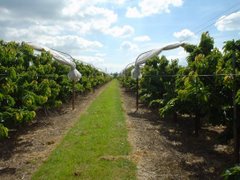
The 2007 harvest began a week earlier than usual. The traditional cherry picking in Kent has changed, the modern commercial cherry orchards against traditional are easier to pick, trees are kept smaller and here at Mansfields we grow them in 2 and 3 row beds, with some of our cherries having rain covers and anti- bird protection.
The cherry season is short, usually up to 4 weeks but is very dynamic, and as proven this year, quite challenging as well. There are a lot of preharvest and postharvest factors that can affect the quality of the cherries. Overall the cherries are very delicate product and Dr. Max Patterson, Professor and Horticulturist at Washington State University, has defined them as:
1. A bag of water, air, and organic chemicals
2. A series of compartments within compartments, individually packaged in a larger master package
3. A fragile, living entity at the cellular level as complex as human life; while at attached to the tree, nourished by the tree; but when detached, must live off of itself at the mercy of the environment.
The final definition implies the fragile nature of a cherry and the challenge facing today’s production. It is critical to harvest during the cooler periods of the day, when the cherries are cooler, and to keep them in the shade once they are harvested. The cherries are picked when firm and when have reached full maturity and colour as they will not ripen off the tree. After being picked it is crucial for the cherries to be held in temperature controlled environment. They are being transported to the packhouse in temperature controlled vehicles and held in humidified chilled air to minimize the vapor pressure difference between the fruit and the external air- warmer cherries lose water much more quickly than cooler cherries!
The selection and packing of the cherries is also done in temperature control environment and the completed product is sent out within 48 hours of being picked.
Our aim is to deliver to the customer a farm-fresh fruit, which are just naturally more delicious and nutritious!
Subscribe to:
Posts (Atom)